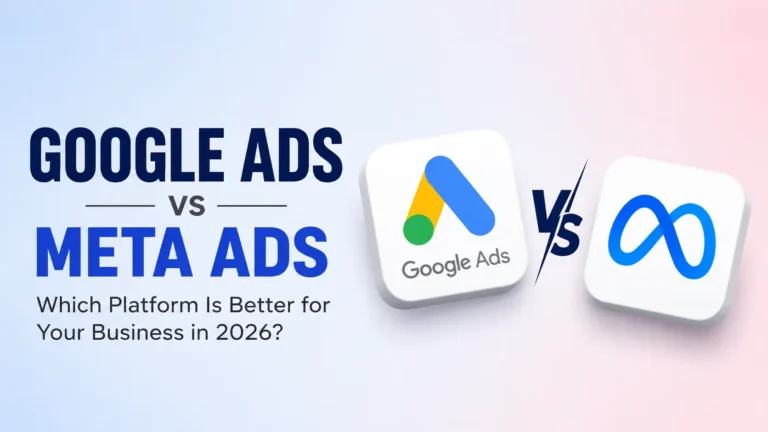
Google Ads vs Meta Ads: Which Platform Is Better for Your Business in 2026?
If you’ve ever tried to figure out where to spend your ad budget, you’ve probably landed in the middle of the Google Ads vs Meta Ads debate. And honestly? It’s one of the most important decisions you’ll make for your business.
Both platforms are giants. Google processes over 8.5 billion searches a day. Meta reaches more than 3 billion people across Facebook, Instagram, and WhatsApp. Together, they control the majority of global digital ad spend. But they work very differently—and what works brilliantly for one business can completely flop for another.
In this guide, we’ll break down everything you need to know: how each platform works, how their targeting and costs compare, which delivers better ROI, and most importantly—which one is right for your business goals in 2026.
What Are Google Ads and Meta Ads?
Google Ads
Google Ads (formerly Google AdWords) is a paid advertising platform that lets businesses show ads across Google Search, YouTube, Gmail, and millions of partner websites through the Google Display Network.
The core mechanic is intent-based advertising. When someone types “best CRM software for small business” into Google, they’re actively looking for a solution. Google Ads lets you place your offer right in front of them at that exact moment. You bid on keywords, and your ad shows up when someone searches for those terms.
Ad formats include:
- Search ads (text ads in Google results)
- Display ads (banner/image ads across websites)
- Shopping ads (product listings with images and prices)
- Video ads (on YouTube)
- Performance Max campaigns (AI-optimized across all formats)
Meta Ads
Meta Ads is the advertising system behind Facebook, Instagram, Messenger, and the Audience Network. Unlike Google, Meta is built on interest and behavior-based targeting rather than search intent.
You’re not reaching people who are actively searching. You’re reaching people based on who they are—their age, location, interests, life events, and online behavior. A well-crafted Meta ad can make someone want something they didn’t know they needed five minutes ago.
Ad formats include:
- Image and carousel ads
- Video and Reels ads
- Stories ads
- Lead generation forms
- Catalog/dynamic product ads
- Messenger ads
Google Ads vs Meta Ads: Key Differences at a Glance
| Feature | Google Ads | Meta Ads |
|---|---|---|
| User Intent | High (active search) | Low–Medium (passive browsing) |
| Targeting Method | Keyword + audience | Interest + behavior + demographics |
| Best Ad Format | Text search, Shopping, Video | Image, Video, Carousel, Stories |
| Average CPC | $1–$10+ (varies by industry) | $0.50–$3.50 (varies by industry) |
| Average CPM | $2–$15 | $5–$14 |
| Lead Quality | Generally high (intent-driven) | Varies (discovery-driven) |
| Speed to Results | Fast (search = immediate) | Medium (requires testing creative) |
| Best For | Bottom-of-funnel, conversions | Top-of-funnel, awareness, retargeting |
| Minimum Budget | Flexible, but competitive niches need $30+/day | Can start from $5–$10/day |
| Creative Requirement | Low (text-heavy) | High (visual content required) |
The biggest takeaway? Google Ads captures demand. Meta Ads creates it.
Google Ads vs Meta Ads for Lead Generation
Lead generation is where both platforms shine—but in completely different scenarios.
When Google Ads Works Best for Lead Generation
Google Ads is your go-to when people are already searching for what you sell.
Think about it: if someone types “emergency plumber near me” or “affordable accounting software,” they have a problem and they want a solution right now. That’s a searcher who’s close to making a decision. A well-structured Google search campaign can turn those high-intent clicks into leads within hours.
Google Ads for lead generation works best when:
- Your product or service has clear search demand
- People use specific keywords to find solutions like yours
- You offer professional services (legal, medical, financial, home services)
- You’re in a B2B space where buyers actively research solutions
- Your sales cycle is shorter and decision-making is direct
A local dentist, a SaaS company selling project management software, or a law firm—these businesses tend to see strong lead quality from Google search campaigns because the intent is baked right into the search query.
When Meta Ads Works Best for Lead Generation
Meta Ads shines when your audience doesn’t know they need you yet, or when you need to build a pipeline over time.
If you’re selling a new fitness program, a boutique clothing brand, or a course on personal finance—people aren’t necessarily Googling for you. But they’re scrolling Instagram. Meta lets you interrupt that scroll with a compelling offer before the need fully forms.
Meta Ads for lead generation works best when:
- You’re building brand awareness alongside capturing leads
- Your product has visual appeal (food, fashion, fitness, home decor)
- You’re targeting a specific demographic or interest group
- You’re running lead gen forms directly inside Facebook/Instagram
- Your audience needs to see you multiple times before converting
The platform’s native Lead Ads feature—which lets users submit their contact info without leaving the app—has become particularly powerful for service businesses, event promotions, and anything that benefits from a low-friction sign-up process.
Google Ads vs Meta Ads Targeting Options
Targeting is where these platforms differ most dramatically.
Search Intent Targeting (Google)
Google’s targeting starts with keywords—the actual words people type into search. You can target broad match, phrase match, or exact match keywords, and layer on audience signals like demographics, location, device, and time of day.
With Smart Bidding and AI-powered campaigns like Performance Max, Google now uses machine learning to find the right users automatically—optimizing bids in real time based on the likelihood of conversion.
Interest and Behavioral Targeting (Meta)
Meta’s strength is its detailed interest and behavior data. You can target people based on:
- Interests (fitness, cooking, travel, technology)
- Life events (recently engaged, new parent, just moved)
- Purchase behavior (online shoppers, frequent travelers)
- Demographics (age, gender, education, income)
- Job titles and employer (useful for B2B)
This level of demographic targeting makes Meta powerful for reaching specific audiences that may not yet be actively searching for your product.
Retargeting Capabilities
Both platforms excel at retargeting—showing ads to people who’ve already visited your website or interacted with your brand.
Google retargets through the Display Network and YouTube, showing banner ads or video ads to past visitors as they browse the web.
Meta retargets through Custom Audiences, letting you re-engage people who visited your site, watched your video, or interacted with your page—then showing them follow-up ads in their feed or Stories.
For most businesses, retargeting on both platforms together creates a powerful multi-channel funnel that significantly boosts conversion rates.
Lookalike and Similar Audiences
Meta’s Lookalike Audiences allow you to upload your existing customer list and find new people who share similar characteristics. Google has a comparable feature called Customer Match and Similar Segments.
Both are excellent for scaling campaigns once you have a proven customer base.
Google Ads vs Meta Ads Cost Comparison
Cost is always a hot topic when comparing these two digital advertising platforms.
Cost Per Click (CPC)
Google Ads CPCs are generally higher because you’re paying for high-intent traffic. The average CPC across all industries is around $2–$4, but competitive sectors like legal, insurance, and finance can see CPCs of $20–$50+.
Meta Ads typically have lower CPCs—usually between $0.50 and $3.50—because the intent is lower and the audience is broader.
Cost Per Thousand Impressions (CPM)
For CPM-based campaigns, both platforms are fairly comparable. Google Display averages around $2–$10 CPM, while Meta averages $5–$14 CPM depending on your audience and placement.
Budget Flexibility
Both platforms are flexible for small budgets. You can technically start Meta Ads with as little as $5/day. Google Ads campaigns can launch with similar budgets, but to get meaningful data in competitive industries, you’ll typically want at least $30–$50/day.
Industry Factors That Affect Cost
Cost is heavily influenced by:
- Competition – More advertisers = higher bids
- Audience size – Narrow audiences often cost more per impression on Meta
- Ad relevance – Google rewards high-quality ads with lower CPCs through its Quality Score system
- Seasonality – Costs spike during holidays, Q4, and peak buying seasons
- Geographic targeting – Urban markets tend to cost more than rural ones
Google Ads ROI vs Meta Ads ROI
ROI is never one-size-fits-all. It depends on your industry, product, funnel, and how well your campaigns are managed.
Which Platform Delivers Faster Results?
Google Ads wins for speed. Because you’re capturing people actively searching, you can launch a search campaign today and see leads or sales within 24–48 hours—assuming your targeting, landing page, and offer are solid.
Meta Ads require more testing. You need creative assets (images, videos, copy), a well-defined audience, and some time for the algorithm to optimize. Expect 1–2 weeks before campaigns start performing efficiently.
Which Platform Scales Better?
Meta Ads often scale more cost-effectively for e-commerce and consumer brands. Once you find a winning creative and audience combination, you can increase budgets and reach millions of new, similar users relatively cheaply.
Google Ads scale is limited by search volume. If only 5,000 people a month search your target keywords, that’s your ceiling—no matter how much you spend.
Real-World Business Examples
- A local HVAC company gets its best ROI from Google Search Ads—people searching “AC repair near me” are ready to call.
- A fashion e-commerce brand scales profitably on Meta through Instagram video ads and retargeting cart abandoners.
- A B2B SaaS company uses Google for bottom-of-funnel conversions and Meta for top-of-funnel awareness and webinar registrations.
- A personal finance coach uses Meta Lead Ads to build an email list cheaply, then converts leads through email nurturing.
Google Ads vs Meta Ads for Small Businesses
Local Businesses
For local service businesses—plumbers, dentists, salons, restaurants—Google Ads is usually the better starting point. Local search campaigns with location targeting put your business in front of people searching for exactly what you offer in your area. Google Local Services Ads (pay-per-lead) are especially valuable here.
Meta can complement local efforts by building community awareness, promoting events, and running retargeting campaigns.
E-Commerce Stores
E-commerce businesses often benefit most from both platforms working together. Google Shopping Ads capture high-intent buyers searching for specific products. Meta’s dynamic catalog ads retarget visitors who browsed but didn’t buy, and Reels/video ads build brand appeal that drives new discovery.
Service-Based Businesses
Coaches, consultants, agencies, freelancers—anyone selling a service where trust and credibility matter—can find success on both platforms. Google search works well for high-ticket services with clear search demand. Meta works well for nurturing prospects through educational content and building audience relationships.
B2B Companies
For B2B, Google Ads generally delivers higher-quality leads because decision-makers are actively researching solutions. LinkedIn Ads are also worth considering for B2B (though more expensive). Meta can work for B2B if you’re targeting small business owners through interest and demographic data, but conversion rates are typically lower.
Which Platform Should You Choose in 2026?
Here’s a practical decision guide:
- Choose Google Ads if…
- People are actively searching for your product or service
- You need leads or sales quickly
- You’re in a service industry (legal, medical, home services, SaaS)
- You have a clear keyword strategy
- Your conversions happen close to the search moment
- Choose Meta Ads if…
- Your product is visual and benefits from creative storytelling
- Your audience doesn’t actively search for your category
- You want to build brand awareness and a loyal audience
- You’re selling to a specific demographic or interest group
- You have creative resources (photos, videos, designers)
- E-commerce, coaching, courses, consumer apps
- Use Both Platforms if…
- You have a budget of at least $2,000–$3,000/month to test properly
- You want a full-funnel strategy (awareness → consideration → conversion)
- You’re scaling an e-commerce or lead generation business
- You want to cover both demand capture (Google) and demand creation (Meta)
- You’re building a long-term, multi-channel digital advertising strategy
The smartest businesses in 2026 aren’t choosing one or the other. They’re using Google to capture intent and Meta to build the pipeline.
How AI Search Is Changing Digital Advertising
The advertising landscape in 2026 looks meaningfully different from just two years ago—and AI is driving that shift.
Google AI Overviews and Search Behavior
Google’s AI Overviews now appear at the top of many search results, synthesizing information from multiple sources before users even click a traditional result. This is changing how people interact with search—and it’s affecting ad strategy.
Users are asking longer, more conversational questions. “What’s the best project management tool for a 10-person startup?” instead of “project management software.” This means your Google Ads keyword strategy needs to account for more natural language patterns and longer-tail queries.
Conversational Search and New Ad Formats
As AI-powered search becomes more conversational, Google is testing new ad formats that integrate into AI-generated answers. Early data suggests that businesses with strong landing pages and high relevance scores are better positioned to appear in these emerging placements.
Meta is investing heavily in AI-powered creative tools and audience prediction models, making it easier to launch effective campaigns with less manual optimization—a big win for small business owners and beginners.
Future Advertising Trends
- AI-generated creative is becoming standard—Meta’s Advantage+ already auto-generates ad variations
- First-party data is more valuable than ever as cookie-based targeting erodes
- Video continues to dominate—especially short-form (Reels, YouTube Shorts)
- Audience-based buying is replacing keyword-only strategies even on Google
- Cross-platform attribution remains challenging but increasingly important
How Businesses Can Adapt
The best online advertising strategy in 2026 combines platform expertise with audience intelligence. Build your first-party data through email lists, loyalty programs, and CRM integrations. Use that data to create Custom Audiences on Meta and Customer Match on Google. Let AI optimization tools work—but monitor performance regularly and feed the algorithms with quality creative and clear conversion goals.
Frequently Asked Questions
Q: Is Google Ads or Meta Ads better for beginners? Meta Ads often have a gentler learning curve for beginners because campaigns are more visual and audience targeting is intuitive. However, Google Ads can be more predictable for businesses with clear search demand. Starting with one platform and mastering it before expanding is usually the smartest approach.
Q: Which platform has a better ROI—Google Ads or Meta Ads? ROI depends on your industry, product type, funnel, and execution quality. Google Ads tends to deliver higher-intent leads, while Meta Ads often offers more cost-efficient reach and discovery. Many businesses find the best ROI comes from running both platforms together in a complementary strategy.
Q: How much should I spend on Google Ads vs Meta Ads? A reasonable starting budget for testing is $500–$1,000 per platform per month. For competitive industries or faster results, $1,500–$3,000/month per platform is more realistic. Always set a daily budget cap and scale only after identifying what works.
Q: Can small businesses compete on Google Ads against larger companies? Yes—especially with tight geographic targeting, long-tail keywords, and strong ad relevance. Larger companies often chase broad, expensive keywords. Small businesses can outperform them by focusing on hyper-specific, local, or niche keywords with high purchase intent.
Q: Which platform is better for e-commerce? E-commerce businesses typically benefit from both: Google Shopping Ads for capturing high-intent buyers, and Meta dynamic catalog ads for retargeting and new audience discovery. If you have to pick one to start, Google Shopping often delivers faster purchase intent traffic.
Q: Do Google Ads and Meta Ads work together? Absolutely—and that’s often where the best results happen. Google captures the demand; Meta builds the brand and nurtures the audience. Running both creates a full-funnel strategy that shortens sales cycles and improves conversion rates across the board.
Q: Are Meta Ads effective for B2B marketing? Meta Ads can work for B2B, particularly when targeting small business owners or professionals through interest and demographic data. However, for most B2B scenarios, Google Ads and LinkedIn Ads tend to deliver higher-quality leads because they capture active research behavior.
Conclusion
When it comes to Google Ads vs Meta Ads, there’s no universal winner—only the right tool for the right goal.
Google Ads is your best bet when people are actively searching for what you sell. It delivers fast, high-intent traffic and works especially well for service businesses, local companies, and anyone with clear keyword demand. Meta Ads shines when you need to build awareness, reach a specific audience, or nurture prospects through compelling visual content.
For most businesses looking to grow in 2026, the real answer is a smart combination of both. Use Google to capture the buyers who are ready now. Use Meta to build the audience who will be ready later.
The key is starting with clarity: know your goal, know your audience, and allocate your budget to the platform that best matches where your customers are in their buying journey.
Ready to put your advertising budget to work? Whether you’re just starting your first campaign or looking to improve your current results, working with an experienced digital marketing strategist can help you avoid costly mistakes and accelerate your ROI. Reach out today for a free strategy consultation—and let’s build a paid advertising plan that actually works for your business.
Ready to take your digital marketing to the next level?
Don't let these mistakes hold your business back. Reach out today and let's build a strategy that actually works for you.
Enquire Now