
Performance Marketing vs Traditional Marketing: Simple Guide

A performance marketing strategist helps businesses pay only for results—like clicks, leads, or sales—instead of spending money on ads that may or may not work. This approach has changed how companies think about their marketing budgets and ROI.
In today’s digital world, businesses face a critical choice: should they invest in performance marketing or stick with traditional marketing methods? Understanding the difference between these two approaches can save you thousands of dollars and help you reach your target audience more effectively.
This guide breaks down everything you need to know about performance marketing and traditional marketing in simple terms. Whether you’re a business owner, marketing professional, or someone curious about digital advertising, you’ll learn which strategy works best for your goals.
What Is Performance Marketing Strategist?
With performance marketing, which is a results-driven strategy, advertisers only pay when particular actions take place. These actions might include clicks, conversions, leads, or sales.
Think of it like this: instead of paying for a billboard that thousands of people might see (but you can’t track), you only pay when someone actually visits your store or makes a purchase.
Key Features of Performance Marketing Stratergist
Measurable Results
Every click, view, and conversion gets tracked in real-time. You know exactly what’s working and what’s not.
Pay for Performance Marketing Strategist
You only spend money when you get actual results. Spend no money on impressions that don’t result in conversions.Data-Driven Decisions
A performance marketing strategist uses analytics tools to optimize campaigns constantly based on real data.
Flexibility and Control
Campaigns can be adjusted quickly based on performance You can make changes right away if anything isn’t functioning.
Common Performance Marketing Channels
- Pay-per-click (PPC) advertising on Google Ads
- Social media advertising on Facebook, Instagram, and LinkedIn
- Affiliate marketing programs
- Native advertising platforms
- Email marketing campaigns
- Influencer partnerships with performance-based compensation
What Is Traditional Marketing?
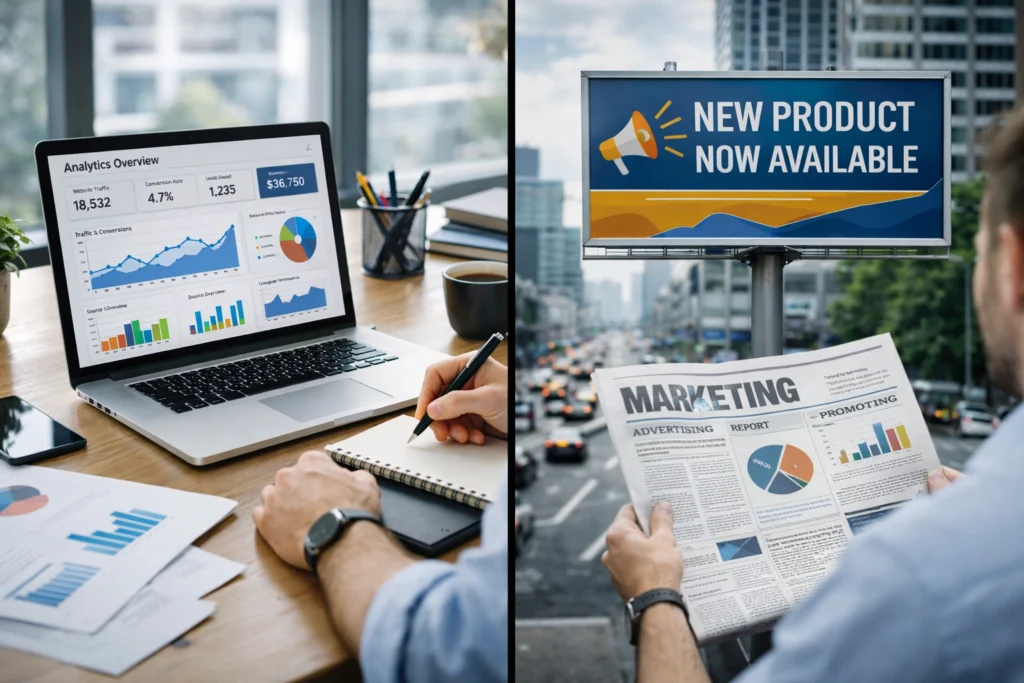
Conventional advertising techniques that have been in use for many years are referred to as traditional marketing.These channels typically require upfront payment regardless of results.
Examples include television commercials, radio ads, print advertisements in newspapers and magazines, billboards, and direct mail campaigns.
Key Features of Traditional Marketing
Brand Awareness Focus
Traditional marketing excels at building brand recognition and reaching large audiences quickly.
One-Way Communication
Messages are broadcast to audiences with limited interaction or immediate feedback.
Difficult to Measure
Tracking ROI can be challenging. You might know how many people saw your ad, but not how many took action because of it.
Higher Upfront Costs
You pay for ad space or airtime before knowing if it will generate results.
Common Traditional Marketing Channels
- Television and radio commercials
- Print ads in newspapers and magazines
- Billboards and outdoor advertising
- Direct mail and catalogs
- Trade shows and events
- Sponsorships
Performance Marketing strategist vs Traditional Marketing: Key Differences
Cost Structure
Performance Marketing strategist: You pay based on results. If your ad generates 100 clicks at $2 each, you pay $200. No results means no payment.
Traditional Marketing: You pay upfront for ad placement. A magazine ad might cost $5,000 whether it generates 10 sales or 1,000 sales.
Measurement and Tracking
A performance marketing strategist can show you exactly how many people clicked your ad, what they did on your website, and which ads generated the most revenue.
Traditional marketing relies on estimates and surveys. You may be aware that 2 million people watched your TV commercial, but you won’t be able to pinpoint the precise number of people that came to your store as a result.
Speed and Flexibility
Performance marketing campaigns can launch in hours and be adjusted in minutes. If an ad isn’t performing well, you can pause it, change the message, or redirect your budget.
Traditional marketing requires longer lead times. A magazine ad might need to be submitted weeks or months before publication, with no option to change it once submitted.
Audience Targeting
Performance marketing allows precise targeting based on demographics, interests, behaviors, online activity, and even specific keywords people search for.
Traditional marketing offers broader targeting. You might choose a radio station that reaches your demographic, but everyone listening hears the same message.
Return on Investment (ROI)
With performance marketing, ROI calculations are straightforward. You know exactly how much you spent and what results you achieved.
Traditional marketing ROI can be harder to calculate. Did that billboard lead to increased sales, or was it your new product line? It’s difficult to isolate the impact.
When to Use Performance Marketing
Performance marketing works best when you need:
Immediate Results
If you need to generate leads or sales quickly, performance marketing can deliver faster than traditional methods.
Tight Budget Control
When every dollar counts, paying only for results ensures no wasted spending.
Detailed Analytics
If you want to understand exactly how your marketing budget performs, performance marketing provides comprehensive data.
Niche Audience Targeting
When you need to reach a specific audience segment, digital platforms offer precise targeting options.
Best Industries for Performance Marketing Strategist
- E-commerce and online retail
- Software and SaaS companies
- Lead generation businesses
- Service providers with clear conversion paths
- B2B companies with defined target audiences
When to Use Traditional Marketing
Traditional marketing makes sense when you want to:
Build Brand Awareness
If you’re launching a new brand or want to reach a mass audience, traditional channels can provide broad exposure.
Target Local Audiences
Local radio, newspapers, and billboards work well for businesses serving specific geographic areas.
Reach Older Demographics
Certain age groups still consume traditional media more than digital content.
Create Prestige and Credibility
Being featured in major publications or on television can boost brand perception.
Best Industries for Traditional Marketing
- Retail stores with physical locations
- Restaurants and hospitality
- Real estate
- Healthcare providers
- Legal services
- Automotive dealerships
The Hybrid Approach: Combining Both Strategies
Many successful businesses don’t choose between performance marketing and traditional marketing—they use both strategically.
A performance marketing strategist might recommend using traditional marketing for brand building while running performance campaigns to drive direct conversions.
Example of a Hybrid Strategy
- Use TV commercials to build brand awareness and trust
- Run Google Ads targeting people searching for your product category
- Retarget website visitors with social media ads
- Send direct mail to high-value prospects identified through digital campaigns
- Track all touchpoints to understand the customer journey
This strategy minimizes the drawbacks of both approaches while maximizing their advantages.
Skills a Performance Marketing Strategist Needs
If you’re considering hiring a performance marketing strategist or becoming one yourself, here are essential skills:
Data Analysis
Understanding analytics platforms, interpreting metrics, and making data-driven decisions.
Platform Expertise
Deep knowledge of advertising platforms like Google Ads, Facebook Ads Manager, and other digital channels.
Testing and Optimization
Running A/B tests, multivariate tests, and continuously improving campaign performance.
Budget Management
Allocating spend across channels and campaigns for maximum ROI.
Copywriting
Creating compelling ad copy that drives clicks and conversions.
Understanding of Customer Psychology
Knowing what motivates your audience to take action.
How to Get Started with Performance Marketing
If you’re ready to explore performance marketing, follow these steps:
Step 1: Define Your Goals
What particular action are you hoping people will take? Make sure your goals are clear.
Step 2: Choose Your Platforms
Start by focusing on one or two of the platforms that your target audience uses.
Step 3: Set Your Budget
Begin with a modest budget you can afford to test and learn with.
Step 4: Create Your Campaigns
Develop compelling ads with clear calls-to-action and landing pages designed for conversion.
Step 5: Track Everything
Install tracking pixels, set up conversion tracking, and monitor your results daily.
Step 6: Optimize Continuously
Review performance data regularly and make adjustments to improve results.
Common Mistakes to Avoid
Expecting Instant Success
Even performance marketing needs time to optimize. Before making significant changes, give campaigns at least two weeks’ notice.
Ignoring Quality Score
Platforms like Google Ads reward relevant, high-quality ads with lower costs and better placement.
Not Testing Enough
Always test different ad copies, images, audiences, and landing pages to find what works best.
Forgetting About the Full Funnel
Don’t focus only on the last click. Consider the entire customer journey.
Setting and Forgetting
Performance marketing requires ongoing management and optimization.
Measuring Success in Both Approaches
For performance marketing, key metrics include:
- Cost per click (CPC)
- Cost per acquisition (CPA)
- Conversion rate
- Return on ad spend (ROAS)
- Click-through rate (CTR)
For traditional marketing, you might track:
- Brand awareness surveys
- Website traffic increases during campaign periods
- Store foot traffic
- Sales lift analysis
- Media impressions and reach
A skilled performance marketing strategist knows how to track both direct response metrics and broader brand impact.
The Future of Marketing
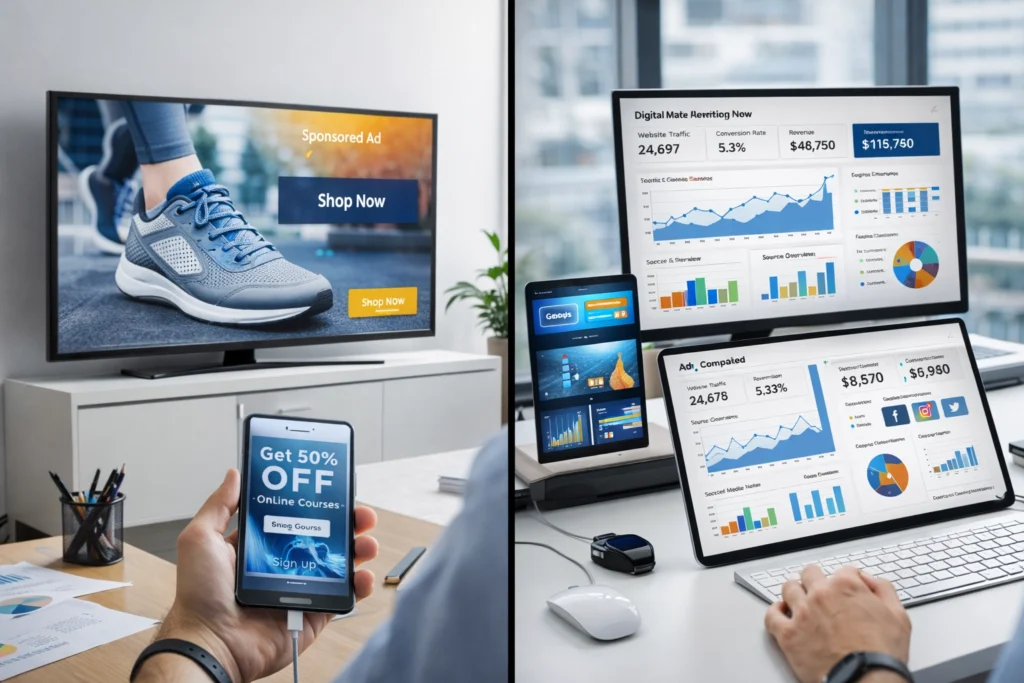
The line between performance and traditional marketing continues to blur. Traditional channels are adopting more measurable approaches, while digital platforms offer brand-building opportunities.
Connected TV advertising, for example, combines the reach of television with the targeting and measurement of digital marketing.
The future belongs to marketers who understand both worlds and can strategically combine them for maximum impact.
Conclusion
Understanding the difference between performance marketing and traditional marketing helps you make smarter decisions about your marketing budget. Performance marketing offers measurable results, flexibility, and cost control, making it ideal for businesses that need to track every dollar spent. Traditional marketing still has its place for building brand awareness and reaching certain audiences.
The best approach often combines both strategies, leveraging each method’s strengths. A skilled performance marketing strategist can help you navigate these options and create a comprehensive marketing plan that delivers real results.
Whether you’re just starting out or looking to improve your existing marketing efforts, focus on understanding your audience, setting clear goals, and measuring everything. Test frequently, start small, then increase what works.
Are you prepared to advance your marketing efforts? Think about speaking with a performance marketing strategist who can evaluate your present initiatives and suggest the best course of action for your particular company objectives.